Beyond Weight Loss: The Worldwide Consequences of the Ozempic Surge
- Anoushka Maya Sanchana

- Jul 31
- 6 min read
Updated: 6 days ago
By: Anoushka Maya Sanchana

In recent years, almost everyone has become familiar with the concepts of Ozempic and Wegovy medications, but surprisingly, not for their intended purpose. Originally developed to aid patients with Type 2 diabetes in managing their blood sugar, these drugs have skyrocketed in fame for an entirely different reason: weight loss. As demand has increased, severe shortages of Ozempic do not just affect hospitals, but also impact the accessibility of pharmaceutical firms and the healthcare industry worldwide.
What is Ozempic?
Many have heard of Ozempic and its effects, but only a handful of people are actually aware of the true purpose of the medication. Initially, Ozempic was a prescription medication created by the Danish pharmaceutical company Novo Nordisk, designed to help those with Type 2 diabetes balance their blood sugar levels. It was released in 2017, after which it quickly rose in popularity and demand for an unanticipated purpose.
It contains the substance semaglutide, which mimics the abilities of the naturally occurring GLP-1 hormone, which plays a significant role in slowing food digestion and controlling appetite. The hormone reduces calorie intake by reducing appetite.
Despite Ozempic initially being approved as a treatment for Type 2 diabetes, many researchers observed weight loss among Ozempic users, leading to the development of Wegovy, another drug formulated for weight management in the obese population. Wegovy was FDA-approved in 2021 as a medication specifically tailored for chronic weight management in overweight and obese patients.
The Ozempic Surge
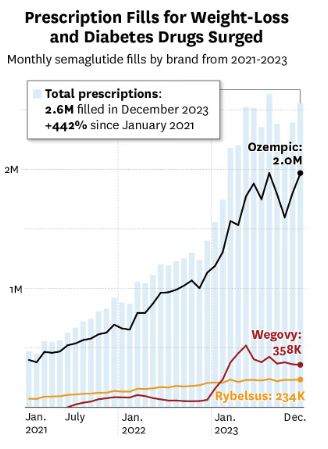
For years, effective weight-loss treatments remained one of medicine's most elusive goals. Diet plans and exercise routines produced underwhelming and inconsistent results. The emergence of semaglutide drugs such as Ozempic and Wegovy marked a revolutionary breakthrough in pharmaceuticals that dramatically changed the scene; what started as a treatment for diabetes rapidly became one of the most recognised medical developments of the decade, with its impact spanning over 80 countries globally.
The turning point came when clinical trials displayed remarkable effectiveness; in the landmark STEP 1 trial, participants taking semaglutide lost an average of nearly 15% of their body weight over 68 weeks. These results far exceeded those of previous weight-loss medications. For millions struggling with obesity, these findings offered something long considered unattainable: substantial yet sustained weight loss.
As expected, the discovery of the effects of Ozempic and Wegovy swiftly circulated far beyond hospitals and research journals. Social media flooded with transformation stories from celebrities and influencers, initiating discussions on “miracle weight-loss drugs.” A large portion of these posts were often informal and based on inaccurate personal experiences and misinformation, with little to no medical referencing. Social media has played an undeniably large role in turning Ozempic from a mere prescription medication into a global sensation.
On TikTok alone, the hashtag #Ozempic has amassed over 1.3 billion views, with millions of videos documenting personal weight-loss journeys and encouraging viewers to see the drugs as a ‘life hack’ rather than a medically regulated treatment. Public perception of Ozempic was strongly shaped by this content, often ignoring the long-lasting implications of the drug. Famous figures have also highlighted the challenges of sustaining weight loss after discontinuing treatment; in a podcast discussion, comedian Gabriel Iglesias reflected on his experience using Ozempic, noting how quickly weight regain can occur.

I got off the Ozempic and immediately I gained back 20 pounds like that. It is scary how quickly you regain the weight.
-Gabriel Iglesias, discussing his experience on Shannon Sharpe’s Club Shay Shay podcast
When Demand Exceeds Supply
As the consumption of Ozempic and other GLP-1 medications surged globally, healthcare systems were confronted with a major imbalance between supply and demand, with shortages worsening as the fad spread and creating widespread disruption across healthcare systems worldwide. Shortages of the drug were so severe in the United States that the Food and Drug Administration (FDA) officially listed semaglutide injections as being in short supply from 2022 until early 2025; during this period, pharmacies struggled to maintain a consistent supply, with some patients being forced to ration or delay doses and others even having to seek alternative medications.
This massive shortage was resolved only in February 2025, once stock was deemed sufficient to meet national demand, although aftershocks and sudden supply constraints still occurred.
The impact of these shortages was clearly most substantial for people with Type 2 diabetes. According to the U.S. Centers for Disease Control and Prevention (CDC), there are 29 million diagnosed diabetic individuals, and approximately a quarter of this population was using GLP-1 injectable medications in the United States in 2024. Clinicians resorted to prioritisation guidelines during acute shortages, with diabetes patients being given preference over individuals seeking the medication primarily for weight loss. Despite this, many diabetes patients still faced difficulties accessing the medication and were forced to rely on other treatments. Healthcare systems and distributors were also affected by the ripple effects of the stock depletion. In Europe, the European Medicines Agency (EMA) and national authorities issued recommendations to manage limited supplies of GLP-1 drugs and heavily monitored consumer markets to maintain stable access for critical patients. Concerns also arose following the emergence of unregulated versions of semaglutide entering markets, potentially harming patients and creating additional regulatory challenges.
The Hidden Risks
In the midst of the Ozempic surge, concerns about its risks have been comparatively underemphasised and everyone overlooks the possible risks and hazards. Unfortunately, the same can be said for the Ozempic rush. Despite the excitement surrounding Ozempic and other GLP-1 receptor agonists, experts caution that the drugs are not without limitations. Common side effects such as nausea, vomiting, and digestive discomfort have been recorded. Besides this, research suggests that maintaining weight loss may be challenging without continued treatment; In the aftermath of the landmark STEP 1 trial, participants regained approximately two-thirds of the weight they had lost within one year of stopping semaglutide, leading some researchers to view obesity as a chronic condition requiring long-term management rather than a quick fix. After all, Ozempic has only been available since 2017, meaning scientists are yet to carry out extensive research on how prolonged use may affect patients.
The surge in demand has also created concerns about accessibility and safety. In June 2024, the World Health Organization (WHO) warned after identifying illegitimate batches of Ozempic being sold online through unregulated suppliers in Brazil, the United Kingdom, and the United States; it noted that global shortages had contributed to a growing market for counterfeit products. Moreover, cost remains a significant barrier; in the United States alone, these medications may cost up to $900 per month without insurance, making them inaccessible to many patients. As demand increases, healthcare systems face the challenge of ensuring access to these treatments at a reasonable price before it affects millions of lives. Dr Eva Madrid, co-lead author of a systematic review of GLP-1 receptor agonist drugs, warns that more evidence is still needed regarding long-term outcomes, particularly in lower-risk populations:
We need more data on the long-term effects and other outcomes related to cardiovascular health, particularly in lower-risk individuals. Weight regain after stopping treatment may affect the long-term sustainability of the observed benefits. More independent studies from a public health perspective are needed.
The Future of Weight Loss
GLP-1 drugs such as Ozempic have rapidly transformed global obesity treatment and weight loss methods, but their rise has also displayed uncertain long-term outcomes. Clinical studies suggest that while patients could lose approximately 15-21% of body weight during treatment, real-world results tend to be lower, with up to 70% of patients discontinuing usage within a year. At the same time, researchers continue to emphasise that these medications are intended for chronic use, not short-term fixes, with weight regain commonly reported after stopping treatment.
However, new findings suggest potential cardiovascular benefits, with evidence that Ozempic may help reduce cardiovascular issues due to its glucose-lowering effects. As of now, healthcare systems are left balancing effectiveness with economy, supply, and long-term safety that is still under study. What began as a diabetes medication has now become a medical and social phenomenon that is still being defined in real time; this leaves us with the question: is semaglutide the future of weight loss medicine, or just the beginning of impediments in science?

This is incredible work.